Posts

Showing posts with the label conference

The Art of Creation

Image
Stimulating one day conference organised by the National Gallery at King’s College London bringing together academics and practitioners from artistic, theological and ecological backgrounds to discuss how three paintings from the gallery reflect themes of creation. The conference was the culmination of this year’s Art and Religion Research programme which had had been discussing the topic via three paintings; Rachel Ruysch’s “Flowers in a Vase” (1685), Claude Monet’s “Flood Waters” (1896) and Van Gogh’s “Long Grass with Butterflies” (1890). Although the networks are closed, they had opened this conference to a wider audience. At times I found it a bit too philosophical for me but as I typed it up I realise I had got a lot of new ideas from it and new things to think about when looking at pictures. The format of the day was three panels with two speakers on each talking about one of the pictures. The Ruysh speakers set up opposing arguments about whether the work was about extincti...

Rubens’s Great Landscapes

Image
Excellent two-day online conference from the Wallace Collection to mark the reuniting of their “Rainbow Landscape” with “Het Steen” from the National Gallery in an exhibition for the first time since they were together in Rubens’s family. Day one looked at Rubens’s creative process and how detailed technical analysis of the work can illuminate this. There were talks on how Rubens had a habit of expanding works as he worked on them with each iteration of the work being a complete composition. We looked in particular at these two particular landscapes and how they seem to have grown in parallel with each other, each starting a small landscapes but then expanding with new panels in two more phases. Day two we looked at what inspired Rubens and I learned about the notion of otium, the art of active leisure including painting and contemplating landscapes. We also looked at Rubens use of mythological figures to show fecundity and fruitfulness in landscapes. Most fascinating was an analy...

Travelling Objects, Travelling People: Art and Artists of Late-Medieval and Renaissance Iberia and Beyond c1400-1550

Image
Dense but fascinating two day online conference from the Courtauld Research Forum on how art and artistic ideas moved between Spain and Portugal, the rest of Europe and into the Americas in the 15th and 16th centuries. The conference took the form of a keynote lecture and five panels of three talks on a shared theme. The keynote looked at the prevalence of Flemish art for the period in Madeira, brought by the trade routes. The speaker, Fernando Antonio Baptista Pereira, had some wonderful pictures of works in the Museum of Scared Art of Funchal. The panels looked at how objects and ideas moved around the Mediterranean and introduced me to the idea of an image chain through the spread of and popularity of prints by Martin Schongauer of the Passion. They also looked at Italian and Flemish artists working in Spain and Spanish artists in Italy, partly moving there in the wake of the Spanish Pope Alexander IV. There were interesting sessions looking at architecture but I think my fav...

Hilliard, Oliver and the Miniature in Context

Image
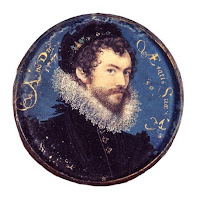
Fascinating international conference at the National Portrait Gallery jointly organised with the Paul Mellon Centre for Studies in British Art and the University of Cambridge looking at new research into the miniature of Nicholas Hilliard and Isaac Oliver. The two day conference complimented the current superb exhibition at the Gallery and consisted of 18 academic papers in seven sessions plus a keynote lecture. There was a fascinating array of topics and I particularly liked the ones looking at the attribution of a picture or the identification of the sitter. It was interesting to hear about other artists working in this field and an ongoing debate as to how many ‘diverse others’ there were. Hilliard claims to have taught many people but can we see their hands in the work? Another ongoing discussion centred around whether the playing cards which were used as the support for the paintings were chosen with specific subjects in mind such as the Ace of Diamonds for royalty. ...

Portraits and Biography

Image
Packed two day conference at the National Portrait Gallery on the relationship between portraits and the lives of their artists organised by the Paul Mellon Centre. This was an academic conference made up of a series of papers under broad subject headings as well as an excellent keynote paper by Ludmilla Jordanova on what portraits of a profession can tell us using the Royal College of Physician’s collection as an example. We also had a talk by the curator of the current exhibition at the gallery on Gainsborough’s family portraits. Interesting topics which came up included whether anatomical pictures can be considered to be portraits, what an Elizabethan portrait of a family can tell us about the lady of the house and how this is supported by writings about her, Portraits Histoiries in 17th century France, images of Royal mistresses in England in the same period and Harriet Hosmer’s cast of the hands of Robert and Elizabeth Barrett Browning. These two days gave me lots ...

Creating Sculpture: The Drawings and Models of Renaissance Sculptors

Image
Amazing two day conference at the Victoria and Albert Museum looking at the creative process of sculpture in the Renaissance and part of the Robert H. Smith Renaissance Sculpture Programme. There was just too much too describe in detail as this was a packed two days of an academic conference. Much to my surprise it had been free including lunches and a drinks reception. The speakers came from all over the world and from British cultural organisations such as the V&A itself, the Sir John Soane Museum, the Ashmolean and many more. Sessions looked at how sculptors used drawings and models in the various stages of creating a work. We looked at highly finished commissioning drawings often preserved in lawyers’ offices as part of the contract for a work, studio sketches and wonderful drapery drawings on linen from Verrocchio’s studio possibly done on linen for longevity of studio use. For models we looked at two Michelangelo ones where he appears to have taken a black of cla...