Posts

Showing posts with the label reproductions

Medieval Multiplied: A Gothic Ivory and its Reproductions

Image
Niche but  fascinating exhibition at the Courtauld Gallery exploring how different technologies of reproduction have shaped encounters with artworks since the 19th century. The main focus was on an ivory mirror case from the Victoria and Albert Museum collection of the “Castle of Love”. The show discussed the different types of casts which has been made of it to spread its image and allow study along with print versions of it. The original was there and I was surprised at how poor the modern 3D printed version was. The show also looked at the use of new technology in the 19th century from glass slides to brass rubbings used by art historians. Closes 14 February 2025

ReaCH : Towards a New Convention on Digital Reproductions

Image
Interesting afternoon at the Victoria and Albert Museum to mark the launch of a new international declaration on digital reproductions which allow museums and galleries to produce, store and shares works from their collection. The keynote speech, given by Bill Sherman, Director of the Warburg Institute, looked at the history of reproductions. He pointed out that most of the Greek statues we know come from Roman copies   and siting the V&A’s own cast court as an example from the museum world. He also told us that the first declaration on reproduction was pioneered by Henry Cole who was first director of the V&A. That declaration had lasted since 1867 but 150 years later a new one was needed for the digital age. This was followed by an interesting panel discussion about the challenges and possibilities which the internet and brought to the cultural world and looked at different approaches from charging to providing free to see the collections used. The after...

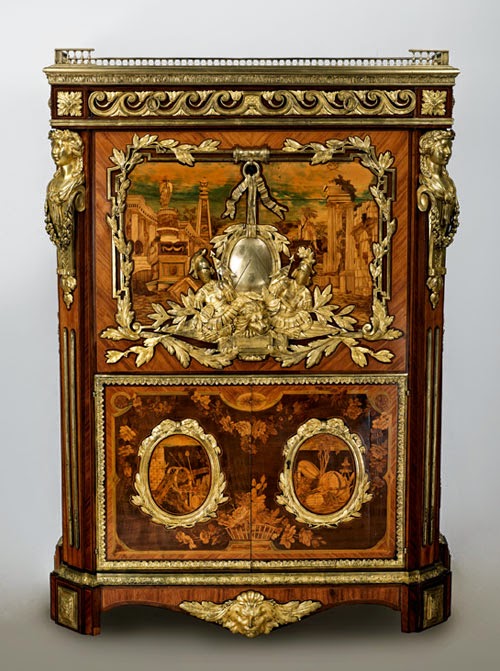
Reproducing the 18th-century: Copying French Furniture

Image
Interesting display at the Wallace Collection looking at the 19th century fashion for reproducing French 18th century furniture. To do this it took a piece from its own collection made in 1776 and compared it to a reproduction of the piece made in about 1880. Oddly the earlier piece has the cruder construction because less attention was paid to what couldn’t be seen. However it’s decorative marquetry was much finer with some of the pieces engraved to enhance the detail. This furniture was not necessarily made to deceive but more likely because there was a fashion for the style creating a demand which couldn’t be met from originals.   I liked the way some of the detail such as cupboard doors were shown directly side by side and it was quite fun to try to guess which was which.