Posts

Showing posts with the label Foundling Museum

Klimt and Beethoven: Artistic Rebellion in Fin de Siècle Vienna

Image
Excellent online lecture   from the Foundling Museum looking at Klimt’s Beethoven Frieze as part of their music and art series. Sarah Jaffray, an art historian, led us through what was   happening in art in Vienna around 1900 and the role of the Secession movement. She described their HQ building which the frieze was shown and explained how it was a radical space for showing art. She then talked about why the movement was attracted to Beethoven even though this was more because of the image of him in Mahler’s novel “A Pilgrimage to Beethoven”. This led to the 14th Secession exhibition being devoted to the composer to mark the 75th anniversary of his death, focused on a sculpture of him by Max Klinhen. The frieze decorated an anti-chamber to the sculpture and Jaffray led us though the iconography of it in some detail.

A Grand Chorus: The Power of Music

Image
Engaging exhibition at the Foundling Museum looking at the power of singing together via the Hallelujah Chorus. The show started by looking at the chorus by Handel which premiered in Dublin in 1742 but from soon after was performed annually at the Foundling Hospital to raise money for the institution. On the top floor they examined the origins of the work and how it has been performed since. On the middle floor they focus on the role of music at the hospital from the choir of hospital to the boy's band which trained boys to go into military bands. They also looked at modern interpretations of the work and I found myself dancing to "Too Hot to Handel : The Gospel Messiah". Look it up! In the basement was a wonderful video installation called "We Are Together Because …."   the result of a two year project at a community school near Lisbon tracing the project from experimental vocal warm up to a final performance. It consisted of a main screen and five small...

The Symbolism of Music in Dutch Genre Painting

Image
Slightly random online lecture from the Foundling Museum looking at music in Dutch Golden Age paintings. This was one in a series of talks on music in art and as such was geared to a more general audience rather than an art historical one. Mariska Beekenkamp-Wladimiroff, Founder of Art Historical London took us though the meaning of various musical instruments and of music in pictures in general as well as introducing the idea of symbolism in Dutch art. She had excellent illustrations but I would have appreciated a bit more structure to the talk possibly building to a conclusion.

Sounding Presence: John Blanke & the Power of Music

Image
Interesting online lecture from the Foundling Museum discussing an image of John Blanke, a black trumpeter at the court of Henry VIII. Michael Ohajuru introduced us to Blanke who is the first person of black African descent for whom we have a historical record and an image. He explained how black trumpeters where not new but had been known in the Holy Roman Empire and took us through some images of them. He then led us though the “Great Roll of the Tournament at Westminster in February 1511” explaining what the event was and how it was depicted. In particular he pointed out the two images of Blanke. Finally he looked at the documentary evidence we have on Blanke including records of him playing at Henry VII’s funeral and Henry VIII’s coronation. The talk was a great example of using images and documents together to give a insight into history.

Scandinavian Art 1750-1910

Image
Interesting study day from the London Art History Society held at the Foundling Museum looking at Scandinavian art in the 19th century.   Kathy McLauchlan started by giving an overview of the period and how the art culture in the various countries operated with royal collections, academies and independent art societies called Konstforening. She then moved through the period chronologically which also fell into geographical areas over the next three talks.   The pattern of development was similar to Europe as a whole partly as the period was so dominated by Paris. We looked at how tastes moved from the Classical to the naturalistic, through Impressionism and social realism to Symbolism. It was fun to discover new artists and I particularly fell for Christoffer Eckersberg’s clean detailed works very evocative of one of his teachers, David. However I chose this wonderful portrait Frederick Sodring by Christen Kobke which I loved to illustrate the post.

Take This Token

Image
Charming exhibition at the Foundling Museum of work by contemporary visual artists, writers and designers inspired by the museum’s unique collection of tokens. I always find the tokens, left by parents of foundlings as way of identifying themselves if they managed to come back to claim the child later. Over the years since the museum opened in 2004 they have invited artists and writers to respond to the tokens and this show brought some of those responses together. They were shown with two of the original cases of tokens which the hospital started to display in the 19th century. My favourite work was this watercolour by Mary Feddon. Closed 10 September 2023  

Music for the King: The Concert of Antient Music

Image
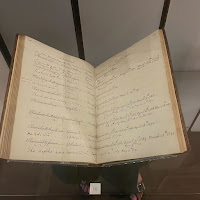
Interesting exhibition at the Foundling Museum exploring the eighteenth-century concert series, the 'Concert of Antient Music'. These concerts began in 1776 with a programme of about 12 concerts a year until 1848. They were programmed by nobles but managed by the conductor, beginning with Joah Bates. They featured ‘ancient’ music, defined as pieces more than 20 years old, at a time when concerts tended to feature new works. This often includes works by Handel who was one of the founders of the museum. The display consisted of portraits of the main protagonists and ephemera related to the concerts including a cabinet on Sarah Harrop, the soloist and wife of Joah Bates. I loved this register of performances from the start to 1791. The show revealed an aspect of the 18th century which I hadn’t know about before. My father was a geek about the music of this period and he would have loved this display.   Closed 8 October 2023    

Finding Family

Image
Thoughtful exhibition at the Founding Museum exploring what family means. The core of the show were three paintings on loan from the National Gallery shown with work by contemporary artists and poems by people on the museum’s training and mentorship programme, “Tracing Our Tales”. The show was themed around questions about what family is, whether it is blood, connection, bond or love. The pictures were well used to illustrate the ideas. It was fascinating to read the connections the contemporary artists had to the subject. I was particularly moved by the story of Louise Allen whose adoptive mother had said she didn’t want her yet Allen went on to care for her and to foster over 20 children herself. It was lovely to see the National Gallery works by Hogarth, Gainsborough and the Le Nain Brothers in a different context. It made you look at them in a different way. I really enjoyed seeing Hogarth’s portrait of the Graham children at eye level so you could look into their faces. C...

Radical Empathy

Image
Interesting exhibition at the Foundling Museum of staged photographs by Akytom with words from poems by Yomi Sode. The works explore the idea of radical empathy, and I quote from the commentary ” a concept developed by Terri Givens, Professor of Political Science at McGill University, is more active than sympathy. It involves working to understand not just the experiences and views of others, but the origins of our own biases, in order to turn understanding into practical action for change to promote social and racial justice.” I understood this idea more when I realised the photographs were based on Caravaggio paintings using similar lighting techniques. It played on the idea that in his day the artist was seen as a murder but over time we have had more empathy for him and he is now viewed as “a man of his time” quoted in a poem by Sode. Whatever they meant the photographs were monumental and as moving as Caravaggio’s paintings. Closed 15 January 2023  

Tiny Traces: African & Asian Children at London’s Foundling Hospital

Image
Moving exhibition at the Foundling Museum tracing children in their care in the 18th century of African and Asian descent. As ever from this museum the show was wonderfully researched and told the story of a selection of children in their care. It put their lives in the context of the expanding colonialism in the century and the lives of black people in London. 1 in 1000 of their foundlings were off African or Asian descent. There were some remarkable glimpses of lives which could be built into novels. Such as Anne Watson whose mother Martha born in Calcutta, had left her child but returned for her when she married William Green from Barbados. They planned to leave for the x-slave colony at Sierra Leone. Also Fanny Kenyon whose story is told in more detail in an excellent booklet that goes with the show. The display didn’t shy away from the fact that many of the governors and donors of the charity were involved in colonial trade including the slave trade and put this in the cont...

Charles Jennens: Patron & Polymath

Image
Delightful display at the Foundling Museum looking at life of Charles Jennens, librettist off The Messiah. This was just a small display but covered his art collecting, philanthropy and writing. His father died in 1747 leaving him 34 properties in 6 countries. In an inventory of his house, Gopsall, it listed over 500 works of art. Interestingly he was a non-juror, someone who supported the legitimacy of the deposed Catholic Stuart monarchy, although he himself was a devout Protestant. As such he was barred from public office so had time to devote himself to other things. The display included his letter to Edward Holdsworth outlining his idea for Messiah saying he was going to ask Handel to set it to music as well as two portraits of him to introduce you to the display. He seemed such an interesting man that I bought the small book about him that was on sale in the shop. Closes 3 January 2023  

Don't Ask the Dragon

Image
Interesting display at the Foundling Museum looking at the creative process between author and illustrator in producing a children’s book. “Don’t Ask the Dragon” is by Lemn Sissay and Gregg Stobbs and this display shows ideas for the book and the final illustrations along with a conversational commentary between them about the process. It was fascinating to see how ideas changed, presented in same narrative order as the book. I was particularly moved to see that Stobbs the illustrator had given Sissay one of the drawings which wasn’t used for his birthday as it reminded him of the first time they met. Closes 9 October 2022

Superheroes, Orphans & Origins: 125 years in comics

Image
Fascinating exhibition at the Foundling Museum looking at how and why characters in comics are often orphans or foundlings. Using great examples of old and new comic strips they took you through various themes of this phenomena. It was a much more nuanced show than I expected.   There were good modern pieces with commentaries by the artists. It started by looking at this archetypal tale which probably started with Moses and how taking parents away in a story means there is no one to say no. It then looked at superheroes who lost their parents violently who turn to protecting others like Batman and Spiderman, followed by heroes which help us explore difference and identify such as Captain Marvel Jnr who was an orphaned, disabled, newsboy. They talked about how reading a comic strip can fell like reading a diary and looked at the artists who have used it in that way such as Carlos Gimenez who used the form to explore growing up in Social Aid homes in Franco’s Spain. Finall...

Selling a World of Goods - Trade Cards in Georgian London

Image
Fascinating online lecture from the Foundling Museum looking at Georgian trade cards. Jon Stobart from Manchester Metropolitan University set out clearly what these cards can tell us about the retail trade in London in the 18th century and how they changed over the period. He had great illustrations mainly from the John Johnson Collection of Trade Cards. I was particularly interested in the cards which showed pictures of the shops and sometimes how the service worked. I loved one of a lady trying on shoes and another of a couple sitting at a counter being shown goods by the shop keeper. I was also interested to learn that in the 1770s London banned shop signs as they were a hazard to traffic so shop fronts became more important for marketing the goods. Also that in this period the numbering of buildings on street was introduced but before that the shops had to give quite detailed descriptions of where they were such as “St Paul’s churchyard opposite the tree”. Who would have t...

Foundling Portraits Campaign

Image
Small exhibition for a landmark project at the Foundling Museum to commission portraits of some of the last children to pass though the hospital’s care. The Museum realised that they had not portraits of any of the 25,000 children to pass through their doors since 1739. To fill this gap they have commissioned five major artists to create portraits of five former pupils of the Foundling Hospital – to hang alongside the grand paintings of the Hospital’s Governors and benefactors, giving care-experienced children visibility and voice within the story of British art and culture. The prestigious artists chosen , Jillian Edelstein, Mahtab Hussain, David Moore, Ingrid Pollard and Wolfgang Tillmans, reflect the support of Hogarth one of the leading artists of the 18th century for the hospital when it was founded. These were lovely images hung up the main staircase and I hope the plans are to commission more. Wouldn’t it be lovely if they could record all the people still alive who the h...

Ingrid Pollard: Ship’s Tack

Image
Clever exhibition at the Foundling Museum by Ingrid Pollard in response to their current exhibition on George King, a foundling who fought at the Battle of Trafalgar. I would loved to have seen more of this work as it felt a bit sparce. There were nice ceramic models of paper boats which were originally created as part of “Trade Winds/Landfall”, a body of work investigating the importance of winds and sea currents in the historic commerce that crossed the Atlantic Ocean. It would have been nice to have a full flotilla of these. More moving were sections of King’s handwritten autobiography printed onto voile curtains and hung amongst the large portraits in the Picture Gallery. She had chosen sections where he mentions the names of friends or places that had meant a lot to him. Closes 27 February 2022

Fighting Talk: One Boy’s Journey from Abandonment to Trafalgar

Image
Fascinating exhibition at the Foundling Museum looking at the life of George King, a foundling at the hospital who fought at Trafalgar. I love the way the Foundling Museum approach exhibitions, they are rich in research without being heavy and use a few key loans to illustrate the story they are telling well. In this case it was exciting to find the figure head of King’s ship, the Polyphemus alongside a wonderful painting of the Battle of Trafalgar. Obviously, the research was helped by the fact King wrote an autobiography and it was lovely that the handwritten copy was in the show. The commentary told King’s story like a novel and, although the title gives away the two key facts about him, there was a lot more to learn from his apprenticeship to a confectioner where he was bullied by his fellow apprentices, to deliberately looking to be press ganged, though a spell in America, which was told via an excellent video, to his retirement at the Royal Hospital for Seamen at Greenwich an...

Learning Disabilities and the Foundling Hospital

Image
Fascinating online talk from the Foundling Museum looking at how children with what we would now call learning disabilities were treated by the Founding Hospital. Thomas Aird, a volunteer at the Museum, took us through some detailed research he had done on children listed as ‘idiots’ at various times in the hospital, tracking what had happened to them over the years. I was fascinated by the amount of detail he had found on the children, often finding where they had been placed in apprenticeships and in some cases finding out when they died and where they are buried. Most touching was Ann Valley who lived in the care of the Foundling Hospital for the whole of her 83 years. He explained that the term ‘idiot’ was not seen as derogatory at the time, it only became so as narrower definitions of conditions were adopted. He also explained how the issue had become more pronounced following the period of general admission to the hospital between 1756 and 1760 when, in return for government...

Portraying Pregnancy: From Holbein to Social Media

Image
Fascinating exhibition at the Foundling Museum looking at how pregnancy has been portrayed in art. The show starts by pointing out that until recently pregnancy bumps have tended to be edited out of art however there are a few exceptions and the show highlighted these as well as how pregnancy was described and illustrated in scientific texts. The show worked chronologically starting with Medieval depictions usually when illustrating the Biblical story of the Visitation where the pregnant Mary meets her kinswoman, Elizabeth, also with child with John the Baptist. This was nicely shown by a lovely embroidery and some books of hours. The Tudor and Stuart sections were lovely with some good loans including Holbein’s beautiful drawing of Cecily Heron with her stomacher adjusted to accommodate her bulge and a family picture and self portrait of the female artist Mary Beale, probably the first self-portrait of a pregnant woman. It was a nice touch to include a set of pregnancy stays a...

Two Last Nights: Show Business in Georgian Britain

Image
Fascinating exhibition at the Foundling Museum a look at entertainment in Georgian Britain. The show described itself as “a how-to guide to going to a show in eighteenth century Britain” and covered the theatre, the Foundling Chapel, Vauxhall Pleasure Gardens and music festivals. It took you through every aspect from buying a ticket, what to wear, what you’d have seen and where you’d have eaten. The show ranged throughout the museum with the main section in the basement looking at theatre and was designed like the foyer of a theatre. It examined the opera and spoken word plays with sections on the main London theatres of the time and a look at regional touring theatre. I loved the idea that one ticket was printed for the season with the show name and seat numbers being hand written on each ticket. I’d not realised that a box office originally only sold tickets for the boxes with a pay booth for other tickets. The Handel room at the top of the building looked at the gro...