Posts

Showing posts with the label anglo-saxons

The Romsey Rood: an Anglo-Saxon Artefact in the Anglo-Norman World

Image
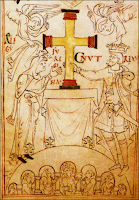
Intriguing online lecture from the London Art History Society looking at a wonderful Anglo-Saxon crucifix on the outside of Romsey Abbey. Richard Plant, author on this period, shared thoughts on the Romsey Rood starting by describing it and comparing it to other crucifixes of the period. I love this period of art but don’t know a huge amount about it so it was fascinating to be introduced to some lovely objects. He then thought about rituals which may have been linked to this work such as the idea of fire for lighting candles being kept by a church door. He also mused on why it was on the nuns side of the church and whether they had some ritual linked to it. Finally he looked at why this Anglo-Saxon work might have been incorporated into a later Norman church. Did it have some sentimental meaning to the local people? Two Anglo-Saxon saints and a king were buried there so was the object linked to one of them? Had the nunnery become a home for Anglo-Saxon ladies post Conquest? Lot...

Illuminating Medieval Art

Image
Comprehensive and enjoyable  online course from HistFest on Medieval art from the 6th to the 14th century. Over four weeks Janina Ramirez led us though this period via recorded lectures and live Q&A sessions. I think the course had run before with the same lectures but the format worked well and the Q&A sessions were lively and interactive. Ramirez was very approachable and welcomed new ideas.   She encouraged those with questions to turn on their video screens leading to some fascinating conversations. She started with the Dark Ages, which she doesn’t want to be called that, looking at how Christian art started to leak into England both from the Roman and Celtic traditions. She talked about the imagery of intertwined animals and the complex riddles used both in art and literature leading up to the Normal Conquest. Post Conquest we looked at the rise of the artist from anonymous craftsman to a period we see more individualism in society and art. Despite this bein...

Meeting Vikings in English Churches

Image
Interesting online lecture from the Churches Conservation Trust looking at how we can see the presence of Vikings though looking at English churches. I had assumed the talk would be looking at possible Viking carving and architectural details but the speaker, Eleanor Parker, looked more at how the dedications of churches showed the Viking presence. She took us through the legends of various saints who the Viking’s favoured including St Edmund, the King of East Anglia. She talked about how, bizarrely they often championed English saints whose deaths they may have been involved in. Was this a political move? King Cnut did a similar thing with St Olaf who he had defeated in battle. S he also looked at saints and traditional for which there is no basis in fact but looking at how the stories may have come about eg St Ragnar whose ‘body’ was conveniently found when rebuilding a church although it is likely his legend was a confusion of the life of Ragnar Lothbrok. She used good illu...

Anglo-Saxon Kingdoms: Art, Word, War

Image
Fabulous exhibition at the British Library looking at the Anglo-Saxons. I studied this period at school and university and anything you could want to be there was as well as lots of new discoveries. I moved from object to object remembering things I had long thought I’d forgotten. The show was nicely organised chronologically around the main kingdoms as they came to prominence the around broader themes of language and literature, the church and conquests. It was a nice touch to end with the Domesday Book treating it not as a tool for Norman conquest but as a reflection of the excellent land records which had been kept by the Anglo-Saxons. My old “Were the Norman’s innovators?” essay plan came flooding back! There were so many highlight’s it’s hard to pick a few but here goes! How about Cuthbert’s bible, the earliest European bound book, which looked as fresh as if it had been made yesterday as it had been in Cuthbert’s coffin. Alternatively the Codex Amiatinus, on loan fro...