Posts

Showing posts with the label Japan

Urushi Now: Contemporary Japanese Lacquer

Image
Interesting display at the Victoria and Albert Museum of contemporary works made in Japanese lacquer. The display explained briefly how lacquer is made but concentrated on how it has been used in this century. The display cases were gently themed but let the beautiful pieces speak for themselves. I think my favourite was this box with a faux zip by Sasaki Gakuto called "Irony". I also loved this box by Suzuki Masaya for its iridescent colours. The display was a lovely opportunity to discover new things. Closes 30 April 2027

Japanese Women Photographers: From 1950s to Now

Image
Stolid exhibition at the Photographers' Gallery looking at Japanese women photographers since the 1950s. The show was well presented under the themes of pioneers, elevating the day, self, gender and society and experiments but it was large, taking over all three floors of their galleries. I liked that it was shown in groups by individual photographers with good information boards including quotes by the artists. However the work lacked a sense of lightness and it all felt quite serious and worthy. I met a friend after and told her where I'd been and as she said "That's a bit niche". I think the “Elevating the Everyday” section was my favourite with street and diary photography. I loved Ushioda Tokuko's pictures of the inside and outside of her fridge as a commentary on her life. I was intrigued by Yanagi Miwa's staged pictures commenting on Japanese elevator girls (although I thought they were air hostesses from the image). The one shown here was us...

Samurai

Image
Intriguing exhibition at the British Museum examining the history of the Samurai. It was a beautifully designed show and covered from their origins in medieval Japan's civil wars through to the 19th century when they had become the elite, cultured ruling class. It also looked at their myths and l egacy. My only moan is, that as ever at the British Museum, the labels were quite long and wordy creating log jams partly because they were set low so if anyone leaned over to look at an object they blocked them. Add to that the fact that quite often they were a distance from the item they were discussing so you had to play a game to match the object to the label. There were some beautiful objects and plentiful use of intricate painted scrolls and prints. I think my favourite object was this charming small dish dated 1700-50 which I felt could be a contemporary shop. I also loved a book described as an I-Spy book for processions to enable people to identify the different clans as th...

Hiroshige: Artist of the Open Road

Image
Useful lecture from ARTscapades introducing the Hiroshige exhibition at the British Museum. I am fond of Japanese prints but don’t know a lot about them so this was a much-needed talk before visiting the exhibition which I have yet to do. Hiroshige was working in the early 19th century so was one of the artists influencing artists like Van Gogh and Whistler. Alfred Haft explained how the show had come about following a gift of 35 prints from the collection of Alan Medaugh which has been enhanced by a further loan of 82 prints from his collection. He talked us through the five sections of the show with illustrations from each of them. He took us through the artists landscape, urban scenes, designs for fans and images of the natural world. I now feel ready for the show.

Salon Culture in Japan: Making Art, 1750-1900

Image
Interesting online lecture from ARTscapades looking at salon culture in 18th and 19th century Japan. The talk focused on a display in the Japan galleries at the British Museum so Rosina Buckland set the scene outlining the museum’s collection room of Japanese artefacts and prints. She also talked us through some recent acquisitions. Akiko Yano then talked about salon culture defining it as privately formed groups of men and women who practiced the same art form or had the same hobby. She talked about how these grouping often but across the rigid class structure of the country. Yano had some lovely illustrations of the idea but they felt a bit random at times rather than forming a narrative. I need to pop up the galleries to take a look for myself. Update: I never got to it.  

Japan: Myths to Manga

Image
Fun and informative exhibition at Young V&A looking at Japanese myths and how they influence modern life and design in the country. I was disappointed at first that the display was aimed at children however it struck a good balance between telling the stories clearly but not being condescending. As it wasn’t a subject I knew about at all I appreciated it. It divided the themed the stories around where they were based from the sky, through the sea to the city. It used a good selection of prints and objects to illustrate the tales. I found the most interesting sections were the ones which looked at modern life and the origins of the stories today particularly in toys and cartoons. Closed 8 September 2024 Reviews Times Guardian Telegraph    

Japan’s Festival Floats

Image
Interesting small exhibition at the British Museum centred on a model of a Japanese Festival float. In just a few pieces the show looks at what the floats are and do, mainly using some beautiful prints of festivals and a video of a contemporary one. It then looked at Yamanaka and Company who made this piece as well as furniture for the European market. The float was given to the museum in 1908 to mark the London Olympics that year. I wonder if they got anything for 2012.   Closed 2 July 2023

Beguiling Beni: Safflower Red in Japanese Fashion

Image
Interesting small display at the Victoria and Albert Museum looking at the Japanese dye 'beni’. The dye is made from safflower petals and produces red hues and an iridescent green. It fades quickly and often represents passionate but fleeting love. The display looks at its uses in fashion, textiles, cosmetics and ukiyo-e woodblock prints. I loved these heel-less shoes by Noritaka Tatehana although I’m not sure I want to wear them! There was also a nice selection of prints showing the dyes use in fashion and cosmetics. Closes 31 March 2024

Japan: Courts and Culture

Image
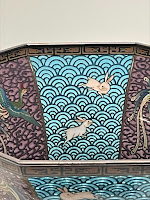
Excellent exhibition at the Queen’s Gallery at Buckingham Palace looking at objects from Japan in the Royal Collection. The show seamlessly blended a number of narratives from the history of British/Japanese relationships, through the techniques used to make the objects to the taste of various members of the Royal Family. I loved the inclusion of some tourist pieces bought by George V when on a trip to Japan when he was in the navy. As ever at this gallery there was a very good audio tour which gave more information without getting in the way of you enjoying the objects. There was an impressive array of Samurai armour and weapons which, I’m afraid leave me a bit cold, but I did loved some glittery spears covered in tiny Mother of Pearl shards. There were some elegant objects. I loved an enamel bowl where the metal lining had been dissolved away to leave just the enamel with light shining through. Also the embroidered screen at the end with a wonderful landscape. I wanted one o...

Kyōsai: The Israel Goldman Collection

Image
Fascinating exhibition at the Royal Academy on the life and work of the 19th century Japanese artist Kawanabe Kyōsai. I must admit I didn’t know this artists work at all but I am fond of Japanese prints so I was interested to see what the paintings of the period might look like and to learn more about an artist who was contemporary with the Impressionists but from a completely different tradition. The commentaries were easy to understand and clear. I loved the long format of a lot of these works and they looked beautiful in the space set in deep displays and the gentle sense of humour in some of them. I did find myself smiling at frog acrobats and, lets be crude, fart pictures. The later work reflected the growing Western influences and the modernisation of the country. You start to see the appear on of a telegraph pole and people in top hats. I liked the idea of calligraphy and painting parties where you paid to go then you could commission work from a selection of artists ofte...

Pictures of the Floating World: Japanese Ukiyo-e Prints

Image
Interesting and beautiful exhibition at York Art Gallery looking at Japanese prints and how they influenced European artists. The show looked at how prints were produced cheaply in large numbers in Japan from the late 17th century making them affordable and popular in a time of peace when the economy prospered and the arts flourished. There were some good examples from all the major artists including some by Hiroshige and Hokusai and an early example by Suzuki Harunobu. There were some lovely examples of European works influenced by the prints but here I must confess I didn’t make notes and now I can’t remember who was featured. I loved the two pictures shown here but I have no idea who they are by. Answers on a postcard please! If only I lived closer and could go and have another look! Closes 29 Mar 2022

Famous Views of Tokyo

Image
Fascinating online lecture from ARTscapades looking at Japanese woodblock prints of Tokyo. I know very little about Japanese woodblocks other than their influence on Western artists so I really enjoyed this talk by Clare Pollard of the Ashmolean Museum to coincide with their exhibition “Tokyo: Art and Photography” . She explained the early links between poetry and prints and the idea of famous areas known through poetry. I was particularly interested in the idea of 19th century guidebooks when peace enabled people to travel around the country and how one of these guidebooks by Utagawa Hiroshige was then expanded into a series of prints “One Hundred Views of Tokyo” in 1856-8. These were beautiful clear compositions and Pollard talked us through a number of them including the wonderful picture of a heavy rain shower used here. She bought the talk up to date by looking at Modernist prints from the start of the 20th century some of which showed the rebuilding of the city after an ear...

Historical City Travel Guides

Image
Fun series of blog posts on the British Museum website imagining contemporary travel guides of ancient cities.   Each follows the pattern of a modern travel guide with sections on how to get there, how to get around, what the sites are, what to eat and where to go shopping. They are illustrated with pictures and objects from the collection. This is such a witty idea but the articles are also packed full of information. I hope there are more to come!   I think my favourite was the Edo one as all the pictures are contemporary Japanese prints including this wonderful one of a busy shopping street. There is also an article on London landmarks using prints and drawings from the collection for those of us dreaming of a day out in London. Edo (Tokyo),early 19th century T hebes, Egypt, 13th century BC Athens, 5thcentury BC Rome, 1st centuryAD Ninevah, 7th century BC London Landmarks

Hokusai: Beyond the Great Wave

Image
Lovely exhibition at the British Museum looking at the life and work of the Japanese print maker, Hokusai, just one of the names he used during his career. The star of the show was obviously “The Great Wave” but it put this famous and much mimicked picture into the context of the rest of this work. The picture was published in 1831 when he was in his early 70s. He trained as a woodblock maker in his teens and in his 40s and 50s became well known as an illustrator for fiction, working on a series of popular books called Strange Tales and there were lovely examples of this work. The wave itself was one of a series 36 views of Mount Fuji using European deep perspective. In Eastern art perspective was shown by distant objects being placed high up in the frame but in a series of prints he did for the British East India Company he started to experiment with Western artists ideas using a low vanishing point and light and shade to give depth. I was also fascinated to see he i...

Minerva X

Image
Rather a mixed exhibition at the Mall Galleries of work by Japanese female artists. On the whole the work in a Japanese style seemed much better than that in a Western style.   Some of the Western style had a feel of a very poor regional amateur art show. However as I read the commentaries I warmed to it more as there were some very heart felt reasons why the artist had painted an image which were more to do with them needing to paint it rather than any market or fashionable forces.   There was a lot of work in dried flowers which was really intricate and beautiful such as Timoe Sei’s “House of Time” which was like a 1930s embroidered garden. There were also a number of shadow boxes which I have not come across before, sort of 3D pictures, and a lot of calligraphy. My favourite work was a picture by Taeko Tsunada which was a cubist style picture of docks.

Gekiga: Alternative Manga from Japan

Image
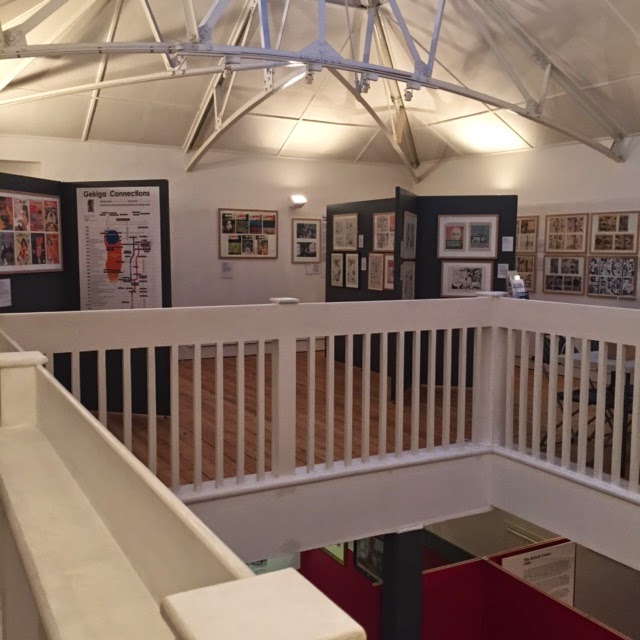
Interesting exhibition at the Cartoon Museum looking at gekiga, an alternative manga from Japan. I had no idea what this was when I went to it, but you know me, I’ll go and see anything. I found the social side of this fascinating. In the post war period in Japan there was a demand for all sorts of entertainment but manga cartoons were seen as juvenile so gekiga grew up as a more adult form created by the children of the war years. Originally people couldn’t afford to buy the books so they were rented. I preferred the early sparser images many of which were very similar to the earlier Japanese print style.   I liked “The Story of the West” with a smoking cowboy. I found some of the later images a bit confused and fussy.

Dressed to impress: netsuke and Japanese men’s fashion

Image
Fascinating little exhibition at the British Museum looking a Japanese men’s fashion and particularly the role played by netsuke. Although I had seen netsuke on the Antiques Roadshow I hadn’t really thought about how they were used so it was really interesting to see a man’s costume and how the netsuke acted as a break to shop the hanging personal objects from falling down. I loved the idea that you chose the netsuke you wore by your mood, the season or depending on who you were meeting. The commentary likened this to the was a modern western man might choose his tie and cufflinks. There were some nice examples particularly a nice ceramic netsuke of a boy holding a lion masque.

Boro

Image
Fascinating exhibition at Somerset House of this Japanese textile work made up of patches and layers of cotton made as bed covers dating from the 17th century to the 20th. Think of a sort of patchwork made from worn out biker jackets! Although they came from a need of poverty they had a certain gentle artistry with a limited colour palate of brown, blue, grey and black as those were the colours commoners were restricted to wearing. The cloth was traded by merchants as disused documents almost like shoddy. Not many have survived as the Japanese establishment were embarrassed at the poverty from which they came. Some of them have a wonderful feeling of depth as the material has been layered complete with its holes. Some of the top layers are little more than threads. This makes you look at them really carefully and speculate on the lives of those who made them. It’s odd but your eye makes modernist art out of them although there is no evidence that the modernists saw the...

Kabuki : Japanese theatre prints

Image
Exhibition at the National Museum of Scotland looking at Japanese theatre prints which were made as souvenirs for theatre goers in the 19th century. Kabuki is a type of stylised theatre including dance, drama, music and acrobatics. Most of the posters were a triptych design with a continuous background but one actor on each sheet. The pictures from Tokyo were in pale muted colours but the ones from Osaka were bolder. There were also pictures of actors off duty which showed a sense of the celebrity culture we see now such as a scene from a calligraphy shop. My favourite was called Dakoku Dancers and showed 2 dancers in almost tartan trousers doing a rather stompy dance in a street with a dramatic vanishing point behind the central figure.  

Women of the pleasure quarters: a Japanese painted screen

Image
Nice display at the British Museum taking one object, in this case a screen from the Yoshiwara , the most famous brothel district of Edo (modern-day Tokyo), looking at the context in which it was made and the image on it. This was a beautiful   screen painted in the 1780s and showing five courtesans and eight trainees. It is an elegant image and the commentaries round it explain what each figure holds and its significance. The commentaries also look at the sort of lives these women would have lived. It gives you a real sense of peeping into a private, past world.