Posts

Showing posts with the label victorians

A History of Sex in Victorian Britain and the British Empire

Image
Intriguing lecture at the National Portrait Gallery using works from the gallery to talk about sex in the Victorian era. Catherine Philips of The University of Bristol introduced us to a number of radical Victorian thinkers both campaigning for rights of sex workers of the time or introducing laws to limit sexual freedoms starting with Charles 'Boatswain' Smith, a Baptist minister in Stepney who established a refuge for sex workers, educating them to be domestic servants and finding them jobs with families moving out to the colonies. She moved on to Josephine Butler and Dadodhal Naoroji who fought to overturn the Contagious Diseases Acts and Annie Besant who republished a pamphlet of sexual education for which she was charged under the Obscene Publications Act. She then looked at Henry Labouchere who introduced the law to criminalise all male homosexual activity in the UK and Sir Richard Francis Burton who wrote about sexual practices he came across when travelling and t...

Picturing the Family : Photography from Victorian Britain

Image
Neat display at the National Portrait Gallery looking at Victorian photographs of family. By picking this subject in a small space it looked at this history of photography at the time from its invention to its popularisation as well as looking at the types of family in the era. I thought it stretched the latter a bit, but it meant they included the Bloomsbury Group so of course I approved. I did find things to Google including Charles Haselwood Shannon and his partner Charles Ricketts shown here. No end date given but these sort of displays are usually temporar y.

Colour Revolution: Victorian Art, Fashion and Design

Image
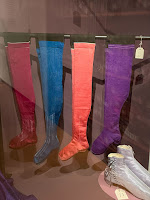
Fascinating exhibition at the Ashmolean Museum looking at colour in Victorian Britain. I had assumed it was going to be about the dyes that were invented in the 19th century but it was much more complex. After a quick look at why we think of the Victorian era as dark it then examined different aspects of colour from Ruskin’s calls to represent the natural world and its colours, through the revival in Medieval colours and the effect of Darwin and the recording of species of animals. It also looked at colours which came from global expansion on both via colonialism and the opening up of Japan. There was a section on dyes and the greater supply of colours for colouring. I particularly loved the brightly coloured stockings. A real discovery from me was the idea of the Tanagra craze, polychrome terracotta statuettes from the 4th century BCE. It explained how the style and soft colours influenced artists like Whistler. I’d not come across them before. Closed 18 February 2024. ...

Prudery and Piano Legs: The Victorian Nude

Image
Fun and informative online lecture by Stella Grace Lyons looking at the role of the nude in Victorian art.  This was the first of Stella’s online lectures I had done, and I was impressed by the quality of it. It was delivered via Zoom which worked well. She had good slides and I loved the fact that they were all labelled which helped when taking notes. She started by talking about William Etty who specialised in nudes in the early Victorian period, an artist I know well as he was based in York where I studies and the gallery there has lots of work by him. He was heavily criticised the time as he painted realistic very human figures. Later in the century the fashion was for nudes in classical settings with pale skin, so they looked like statues. They tended be blemish free and perfect. These were seen as more acceptable. There were some great illustrations of work by Lord Leighton and Lawrence Alma-Tadema. She also looked at the genres of fairy pictures and paintings of femme ...

Seen and Heard: Victorian Children in the Frame

Image
Fascinating exhibition at the Guildhall Art Gallery looking at the representation of children in Victorian art. I must admit I thought this show might be a bit saccharine but it was saved by good commentaries and an excellent timeline of changes to legislation in the period to help children. It was shocking to see that a law was passed in 1847 to restrict children’s working hours in textile factories to 63 hours a week. What were they working before?! The show had nice themes such as at play, at work, in poverty, at school etc and there were some lovely pictures. It’s always nice to see Millais “First Sermon” and “Second Sermon” featuring his daughter pristine in the first and asleep in the second. Also to read again the story of the child model in Leighton’s “The Music Lesson” who was a circus performer turned actress who married an aristocrat. There must be a novel in that! New finds included “Sympathy” by Briton Riviere of a dog sitting on the stairs with a little g...

Victorians decoded: Art and Telegraphy

Image
Strange exhibition at the Guildhall Art Gallery looking at the effect on art of the coming of the Telegraph and the changes that made on Victorian art. It marked the 150th anniversary of the first telegraph cable to be maid across the Atlantic and I rather enjoyed the section looking at this. I hadn’t realised the cable was made in Greenwich, near where I live. As the cable was laid across the ocean it was tested all the way. I was also fascinated by the company code books as telegrams could be read by strangers at various stages so firms moved into sending coded messages for confidentiality. I had assumed the show would be full of art showing people reading telegrams or pictures of cabling work however instead it looked at how people thought in a different way with sections on distance, transmission, coding and resistance. There were lots lovely pictures of beaches, ocean and rocks which were meant to show how people were looking across the seas and how the world was beco...

Sculpture Victorious: the beauty and power of Victorian sculpture

Image
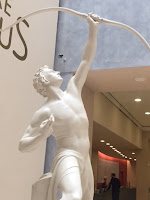
Quirky exhibition at Tate Britain looking at sculpture in the Victorian era. I found it really interesting and well described and laid out however some of the work was truly hideous. I’ll just say a life sized Elizabeth and Raleigh playing chess with the English and Spanish fleets! Why? However I did come away wanting the giant ceramic elephant from the Great Exhibition! This was a time of great technological change and I was fascinated by Cheverton’s reducing machine which allowed him to make small copies of sculptures for the home. I was also interested to think about ‘brand Victoria’ and how sculpture was used to promote the image of the Queen. My favourite section was the one on history and the show included one of the Westmacott life sized figures of the Magna Carta knights. It was billed as the first to be in an exhibition, I wonder how many days it beat its friend in the Magna Carta exhibition at the British Library by! I was also amused as I’d been round the c...

The Victorians

Talk by Jeremy Paxman at the Charleston Festival about his recent television series and book on the Victorians. He took the premise that the social history of Victorian England could be studied via the art of the time. He acknowledged that not all the work was great art but that it did reflect the issues of the day. He was a charming speaker although a little scary at the questions session. He gave a real impression of large works of art being the rock and roll of their day.