Posts

Showing posts with the label 12th Century

Gothic Cathedrals in France

Image
Fascinating two week online course from ARTscapades looking at the development of the Gothic style in France. Jana Gajdošov from Sam Fogg Limited and the Victoria and Albert Museum lead us clearly through four lectures, the first three grouping cathedrals chronologically and stylistically and the last focusing on Notre Dame often seen as the pinnacle of the style. It would have been useful to have a glossary of terms to refer to so I had to do a lot of Googling for spellings when I typed up the notes but as the course progressed you became more familiar with the terms. I liked the way the speaker took us through church by church building up a progression of ideas. I discovered a number of cathedrals I hadn’t heard of before and now have yet another travel itinerary to add to the bucket list.

The Normans in Southern Italy

Image
Confusing online course from the London Art History Society on Norman influence on architecture and material culture in Southern Italy. I say confusing because the history and many of the architectural terms were new to me. I think some people on the course had already done others with the speaker John McNeill so were more familiar with some of the background. It would have really helped to have a glossary of terms and an outline of the people and dates involved in the handout for reference. I know my English Norman architecture of the 11th and 12th century quite well so it might have helped me to make comparisons or say more about why they were different. McNeill had some great illustrations, I suspect many of which he had taken himself, which gave a good sense of the buildings many of which were now ruins. He made good use of floor plans but I’m afraid I did confuse them over time and they were very similar. That said I discovered some wonderful sites and have definitely added ...

Romanesque Mosaic Floors: Images and Uses

Image
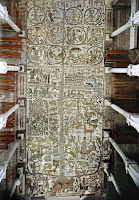
Lively lecture from the London Art History Society introducing church mosaic floors from the 12th century. This was a new topic to me and Richard Plant gave a clear and well-illustrated overview of them. He took us through some wonderful ones including this masterpiece in Otranto complete with weird legends such as King Arthur the cat and the ascent of Alexander complete with a kebab. He talked about some of the themes though maps, the sea, the months of the year and labyrinths with good examples from around Europe. He compared them to ancient Roman examples explaining there is no known link between but there are obvious themes in common. Were Roman mosaics known at the time than we now have? He also compared them to two examples of carpets from the time which were new to me. Yet more to learn about!

The Guest of the Body: Visualising Souls in Medieval Europe 1100-1200

Image
Fascinating online lecture from the Courtauld Research Forum looking at how and why souls were represented on 12th century effigies. Shirin Fozi from the University of Pittsburgh talked about how this research had come out of the work she did on her book on Romanesque effigies as she realised there were a number of pieces which depicted souls going to heaven often shown as being taken by angels. The phrase “guest of the body” to describe the soul comes from a poem by Hadrian written shortly before he died which appears on a number of tombs. She discussed a number of lovely images including the attached of the tomb of Presbyter Bruno in Hildesheim Cathedral from 1195. She also talked about how these images were also popular on reliquaries and she speculated that it may be iconography which is being used for people who their community hoped might become a saint.     

Becket: Church and State

Image
Fascinating online discussion from the British Museum discussing why the dispute between Henry II and Becket was important and its relevance today. The fascination of this talk came from the speakers, Rowan Williams, previous Archbishop of Canterbury and Rose Hudson-Wilkin, previous chaplain to the Speaker of the House of Commons and now Suffragan bishop of Dover ably chaired by Naomi Speakman, Curator of the current British Museum exhibition on Becket. What better placed speakers to talk about church and state in modern Britain as they have lived it most directly. Williams shed light on the nuanced issues of the time and claiming Becket lost the battle but won the war as one of the principles of Magna Carta was “let the church be free”. He also talked about how in current times the church has to follow state law, such as shutting churches during Covid, but that this can be a tension. Hudson-Wilkin talked about being a member of the clergy at the heart of parliament and talked ab...

“From Judgement to Passion”: The Evolution of the Rood in the High Middle Ages

Image
Interesting online lecture from the Churches Conservation Trust looking at the development of the Crucifix in English churches in the Middle Ages. John Munns of Magdalene College, Cambridge explained that until the Reformation every parish church in England had a Crucifixion scene usually on a beam or screen in front the chancel arch. There are no complete sets surviving but he discussed the few remaining fragments and compared these to other Crucifixion images to look at how they developed from 1050 to the end of the 13th century. He talked us through the move from showing a triumphant Christ often clothed as a king to a suffering Christ with legs bent and hanging from his arms in a crown of thorns. He explained how the crown of thorns image became more popular after King Louis IX brought it from Constantinople to France. He also looked at how imagery influenced devotion and visa versa. He introduced us to this beautiful fragment from All Saint’s South Cerney, found with a pair...

Thomas Becket: Murder and Making of a Saint

Image
Stunning exhibition at the British Museum on the life and afterlife of Thomas Becket. I studied Becket both at A Level and at university so I was really looking forward to this show and it did not disappoint. From walking in to see an old friend, the early Limoges casket showing the murder from the Victoria and Albert Museum, I was gripped. The show told the story well using fantastic objects and led you through his life, the murder, the political aftermath, his sainthood and miracles, and how Canterbury became a major pilgrimage site. It is hard to pick out the best objects as so many were wonderful. I loved that they had early copies of some of the five eyewitness accounts of the murder which made you fell you were almost touching the event. I liked the manuscript on his time in exile which was almost like a comic strip. How wonderful to get a 13th century font from Sweden which shows how far and how quickly the news that Henry II had integrated the murder spread. I think my...

Interpreting the Becket Miracle Windows: Canterbury Cathedral

Image
Fascinating online lecture from British Museum looking at what has been learned from bringing a window from Canterbury Cathedral to the current Becket exhibition at the museum. Leonie Seliger from Canterbury Cathedral, Glass Department and Rachel Kopmans from York University Toronto and an expert on the miracle stories of Becket were a great double act dividing the talk between then as a dialogue. They outline the discoveries they had made by combing their expertise. A great piece of detective work! They talked about how some of the miracle stories were shown in the window and how closer observation and a deep knowledge of the stories had enabled them to confirm which story was which. I loved their description of closely studying a figure being washed at Becket’s tomb and finding spots confirming it a the story of Ralph the Leper. I loved Leonie’s story of phoning Rachel to says “Hurray we have leprosy”! There work has also confirmed that one panel in in fact in the wrong window...

Curating “Thomas Becket : Murder and the Making of a Saint”

Image
Fascinating online lecture form the London Art History Society looking at the new British Museum exhibition on Thomas Becket. Lloyd de Beer, curator of the show, talked us through Becket’s life, murder and cult and via that also lead us through the exhibition. He introduced us to some wonderful exhibits such as the Becket Leaves, illustrations from an early life of the saint, shown here, a stained-glass window brought from Canterbury for the show and even a font from Norway which shows Henry II complicity in the murder. I can’t wait to see this show as I did this period for A level. It feels like it covers all the bases and I wonder if my old essays will come flooding back to me. It will be interesting to see what new evidence has come to light over the last 40 plus years!  

Capturing Expertise: Romanesque Sculpture Between Spain and France

Image
Interesting online lecture from Birkbeck looking at the role of slavery in 12th century France and Spain with particular reference to two sculptures on doorways north of the Pyrenees. Rose Walker carefully led us through various documents for the period mentioning slaves or captives then introduced us to the concept of Atlas figures from this period. She then focused on two beautiful examples from the central columns of portals to churches as Oloron-Saint.Marie and Morlaas. I found the Oloron figures, shown here, particularly fascinating for their detail and the fact they wear different clothes, one’s robe is edged in pearls and the other is embroidered. They are bound with an intricate realistic chain. They appear to be wealthy figures but are captives. Is this a literal depiction or a symbolic one? I must admit I then didn’t quite understand how Walker reached her conclusion to speculate whether these figures in fact represented the stone mason’s themselves and to wonder if ar...

Wording the Crucifixion: Art, Inscriptions and Polemics of Two Romanesque Ivory Crosses

Image
Stunningly  detailed online lecture from the London Art History Society on two ivory Romanesque crosses. Sandy Heslop from University of East Anglia took us through the iconography of the Gunhild Cross from about 1100 now in Copenhagen and the Cloister Cross from 1180 now in New York. He described then in detail with particular reference to the inscriptions on them and great illustrations. I hadn’t known either piece before and was fascinated by the detail of them. He went to speculate convincingly on whether a Christ figure now in Oslo was originally from the Closter Cross linking it’s style to a roundel of the Deposition of Christ on cross. He then looked at where and who each cross might have been made for drawing the conclusion that the maker of the latter cross may have known the earlier piece or at least come from the same tradition of art in Saxony under Henry the Lion. I was interested in the links he made to the anti-Semitism of the time of the First Crusade and the...