Posts

Showing posts with the label Paul Mellon Centre

The Body of the Maharani: Portraiture, Gender and Empire at the Royal Academy 1791–1865

Image
Excellent online lecture from the Paul Mellon Centre discussing a portrait of the Maharani Jind Kaur which was shown at the Royal Academy annual show in 1865. Adam Eker, from the Metropolitan Museum, which has recent acquired this work by George Richmond, took us though how the picture was commissioned by the sitter’s son, Duleep Singh, possibly to mark the return of her jewelry from the British government. He put the work in the context of other work representing the Indian subcontinent in Royal Academy shows and in particular works which engaged with the idea of women in purdah. He talked about how the women were often exoticized. He then talked about how it was shown at the Royal Academy show. The Maharani was a well-known, although controversial, figure in London so the work drew the critics and Eker outlined some of the press reporting of the work. This was a clearly explained overview of ongoing research to inform an exhibition at the Met in collaboration with Tate Brita...

John Singleton Copley’s “Watson and the Shark” and the Taste for Flesh

Image
Fascinating online lecture from the Paul Mellon Centre focusing on John Singleton Copley’s picture “Watson and the Shark”. This talk was given by Nika Elder from the American University of Washington, as the last in a series of talks entitled Georgian Provocations. This picture keeps cropping up in talks at the moment, as it is set in the Caribbean and features a black figures, so it was interesting to hear a bit more about it. Painted in 1778 in England but by an American artist who had recently crossed the Atlantic, it shows the real life rescue of Brook Watson from sharks when he was 14. It is unclear if Watson commissioned the work but he certainly went on to own it. He lost a leg as a result of the incident but the picture shows him whole and naked in the pose of a classical statue but on its back. It is making him into a classical, heroic and perfect figure. Elder went on to discuss the possible wider meanings of the picture from the sharks representing the Spanish, to an ...

A Black King in Georgian London: British Art and Post-Revolutionary Haiti

Image
Fascinating online lecture from the Paul Mellon Centre as part of their Georgian Provocations Series  focusing on a portrait of Henri Christophe, King of Haiti. I didn’t know anything about this work and its pendant picture of the king’s son and Esther Chadwick from the Courtauld took us through several aspects of the picture. She begun by telling us the story of Christophe who came to power after the Haitian Revolution. She also looked why the artist Richard Evans went to Haiti and the historic precedents behind the imagery used. The most interesting section looked at how the pictures came to be shown in the 1818 Royal Academy show probably having been sent to William Wilberforce and submitted to the show by him as part of the abolitionist agenda. She also talked about the other works there were shown with it in particular how these works were hung either side of Turner’s “The Field of Waterloo”, speculating if the whole group was commenting on the fall of Napoleon.  

The Haunted Eighteenth Century: Fuseli’s “The Nightmare”

Image
Interesting online lecture from the Paul Mellon Centre for Studies in British Art in their Georgian Provocations series focusing on “The Nightmare” by Henry Fuseli. Martin Myrone, Head of Grants at Paul Mellon Centre and previously at Tate Britain, took us though the imagery in the painting and its reception at the time it was shown at the Royal Academy show of 1782. He looked at how quickly prints became available and it was copied by other artists. It was soon used by satirists and has become a cultural icon even to the present day. He explained how this was despite the fact the picture was in private ownership and not on view until the mid-20th century. Its fame was spread by via the prints and puns. The talk was followed by a lively Q&A session which brought up more interesting ideas such as whether the simplicity of the image allowed it to be lampooned easily, who owned it and why and how its vagueness has allowed for many interpretations.  

Hilliard, Oliver and the Miniature in Context

Image
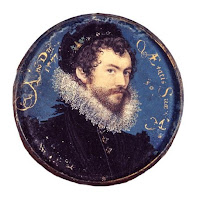
Fascinating international conference at the National Portrait Gallery jointly organised with the Paul Mellon Centre for Studies in British Art and the University of Cambridge looking at new research into the miniature of Nicholas Hilliard and Isaac Oliver. The two day conference complimented the current superb exhibition at the Gallery and consisted of 18 academic papers in seven sessions plus a keynote lecture. There was a fascinating array of topics and I particularly liked the ones looking at the attribution of a picture or the identification of the sitter. It was interesting to hear about other artists working in this field and an ongoing debate as to how many ‘diverse others’ there were. Hilliard claims to have taught many people but can we see their hands in the work? Another ongoing discussion centred around whether the playing cards which were used as the support for the paintings were chosen with specific subjects in mind such as the Ace of Diamonds for royalty. ...

Portraits and Biography

Image
Packed two day conference at the National Portrait Gallery on the relationship between portraits and the lives of their artists organised by the Paul Mellon Centre. This was an academic conference made up of a series of papers under broad subject headings as well as an excellent keynote paper by Ludmilla Jordanova on what portraits of a profession can tell us using the Royal College of Physician’s collection as an example. We also had a talk by the curator of the current exhibition at the gallery on Gainsborough’s family portraits. Interesting topics which came up included whether anatomical pictures can be considered to be portraits, what an Elizabethan portrait of a family can tell us about the lady of the house and how this is supported by writings about her, Portraits Histoiries in 17th century France, images of Royal mistresses in England in the same period and Harriet Hosmer’s cast of the hands of Robert and Elizabeth Barrett Browning. These two days gave me lots ...