Posts

Showing posts with the label Caravaggio

Forging the Baroque: Histories of Neapolitan Art in the Long 17th Century

Image
Interesting online course from the London Art History Society looking at how the artists of Naples developed a Baroque style in the 17th century. Giulia Martina Weston, an associate lecturer at the Courtauld Institute of Art, led us through the topic with six well planned lectures. Day one focused on the effect of Caravaggio having worked in the city and how artists either adopted or rejected this style. We then looked at Luca Giordano and his work in the city as well as in Florence, Rome and Venice. Day two concentrated on architecture in particular the work on Cosimo Fanzago. The first lecture focused on the Certosa de San Martino talking us through its design and decoration in detail. The second lecture then broadened out to look at his work for the religious orders and his secular commissions. The final day looked at Mattia Preti and Salvator Rosa, artists from Naples who worked further afield. We ended by looking at the art market examining how much different artists were p...

Caravaggio’s Victorious Cupid and the Gemäldegalerie, Berlin

Image
Interesting online lecture from the Wallace Collections discussing how Caravaggio’s “Victorious Cupid” came to be in the Gemäldegalerie in Berlin. Neil McGregor, former director of the National Gallery and now chair of the advisory board of the Humboldt Forum in Berlin, was interviewed by Xavier Bray, director of the Wallace Collection to mark the Wallace Collections showing the painting, on loan from the Berlin gallery. They began by talking about the picture itself with Bray sharing that the gallery was not allowed a poster of the painting for the show unless they put the label over the boys genitals. They talked about the Giustiniani brothers who commissioned the work and about other works by Caravaggio which they owned. They then discussed hat happened to the collection when it was sold in Paris in 1812 and how it was shown there for a number of years almost as a public show and how it influenced French artists of the time. We then went into a rather complex discussion of ...

Caravaggio’s Cupid

Image
Brilliant and subtle exhibition at the Wallace Collection presenting Caravaggio's "Victorious Cupid”. The painting, from 1602 is on loan from the Gemäldegalerie in Berlin, is placed within the context for which is was painted. The introductory room introduces you to Rome at the time and the artist and patron. If you then turn right you enter a subtle recreation of the patron, Vincenzo Guistiniani's gallery of classical sculpture.   At the centre is an Aphrodite from Guistiniani's collection with an invocation of the view from the window of his palace at the far ending showing the church for which Caravaggio had painted his St Matthew paintings. Around the edge are reproductions of engravings of classical subjects. The blurb fails to mention that these were all in the collection and the engravings all come from a catalogue of the collection which I learnt from the lecture I'd done on the painting a few days before. The painting itself is shown in the room to th...

Caravaggio’s Cupid (talk)

Image
Excellent online lecture from ARTscapades introducing the exhibition of Caravaggio’s “Cupid” from Berlin and putting the work into context. Richard Stemp elaborated on this two room exhibition which I went to a couple of days after the talk so look for a blog of the show next. His first talk looked at the first room recreating Vincenzo Giustiniani’s sculpture collection. He used this to explain where Caravaggio was in his career at this point and his relationship with various patrons including the Guistiniani brothers. He explained how the engravings reproduced around the walls were from the catalogue of the collection by the curator of the collection, Joachim van Sandrart in the 1630s. In the second half he moved into the other room which holds the Cupid himself and two sculptures. He put forward some interesting ideas of other works of art which influenced the Cupid and went into some detail about the meaning of the work and precedents for it.   He also discussed how, althou...

Love Conquers All, Caravaggio Goes to Jail

Image
Fun online lecture from the Wallace Collection examining Caravaggio’s life in Rome. The talk complimented the museum’s exhibition of Caravaggio’s cupid painting and set it in context. Andrew Graham-Dixon, art historian and author of an excellent biography of the artist, led us through Caravaggio’s years in Rome from his arrival to his rapid departure after murdering someone. He told the story in a lively and colloquial style making the period feel very alive.  

Caravaggio's World : Elizabeth Currie and Helen Langdon in Conversation

Image
Lively discussion in the Supporters’ House at the National Gallery looking at the influence of the world around him in Caravaggio’s art. Elizabeth Currie, who has written a book on clothing in Caravaggio’s art, joined Helen Langdon, a biographer of the artist to talk about some of his genre works painted in Rome. They outlined how there were two sides to the city at this time with a papal and cardinal’s courts existing alongside a disturbing underworld following an explosion in the population of the urban poor. Taking a selection of works they examined them in this context with Currie bringing insight into what the clothes tell us about the characters. This led to a fascinating discussion about feathers! My fact of the day is that the same material appears in the dress of “The Penitent Magdalene” and the lining of the man’s cloak in the second version of “The Fortune Teller” and that it may be ecclesiastical fabric.

The Last Caravaggio

Image
Interesting exhibition at the National Gallery focusing on Caravaggio’s “The Martyrdom of St Ursula”. Painted in 1610 this is Caravaggio’s last painting which is on loan from Naples. It was shown with the gallery’s own “Beheading of John the Baptist” of a similar date as well as a letter found in the Naples archive in 1980 which authenticated the work and accounts of his death from two early biographies of the artist. When I went, quite early in the run of the show, it was very busy with a confusing queuing system up the stairs. It was all a bit of a scrum! I was pleased to see it was popular but it left little mental space to commune with the work. I had actually seen the work just a few months earlier in Naples where I had managed to spend some quiet time with it. A much better experience. Closed 24 July 2024 Review Times Guardian Evening Standard    

Curator’s Introduction: The Last Caravaggio

Image
Interesting online lecture from the National Gallery introducing their small exhibition focused on Caravaggio’s “The Martyrdom of St Ursula” on loan from Naples. Francesca Whitlum-Cooper took us through the life of Caravaggio and where this picture fitted into it and then looked at the story of St Ursula pointing out this was an unusual way of showing her martyrdom as images usually focused on the thousands of virgins she travelled with. She then looked at the history of the painting and in particular a letter found in the Naples archives in 1980, which referred to a painting of the subject by Caravaggio which had been left out in the sun which made the varnish soften, which was used to identify the work. I would have liked to have less about the life of the artist, which I have frequently covered in talks, and more about how they borrowed the picture and why they chose the works to show with it. I have since been to the show so look out for my review of it.

Caravaggio in Cameroon Marc Padeu and Jennifer Sliwka in Conversation

Image
Fascinating online interview from the National Gallery with contemporary artist, Marc Padeu. Padeu was interviewed by Jenny Sliwka, a Renaissance art historian, about the influence of Caravaggio on his work. She took five of his pictures of a religious society in Cameroon known for their production of bananas and coffee and analysed the links between the two artists. Padeu’s were bright pictures often closely based in composition on Caravaggio. The protagonist often have brightly coloured hair to reflect the effect of the chemicals they work with. He talked about how he put himself through school by painting frescos in churches and while painting a black Madonna and Child he realised the religious power for the nuns in the church he was working on of seeing biblical figures who looked like them. It was a slightly awkward talk as Padeu didn’t speak very good English so it was pre-recorded and Sliwka interviewed him in French and then translated. This made the discussion a bit sti...

Caravaggio and his legacy

Image
Excellent days’ workshop at the National Gallery looking at the work of Caravaggio and how other artists were influenced by it led by Sian Walters. In the morning we looked at the life and work of Caravaggio and how innovative it was in its own day. We looked at the main works and talked about how his circumstances at any given time may have affected them. We then looked at his influence on others both in his own life time and in the years soon after his death using works in the current “Beyond Caravaggio” exhibition at this gallery. In the afternoon we looked at a group of Dutch artists called the Utrecht Caravaggisti who visited Rome in the early 17th century and saw Caravaggio works. They took the ideas back to the Netherlands and how they are also responsible from the idea   of showing a candle as the source of light which Caravaggio did not do. We talked about their work and their patrons. We finished the day with the wonderful story of how the “Taking of Chr...

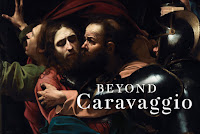
Beyond Caravaggio

Image
Clever exhibition at the National Gallery looking at the influence of Caravaggio. I was pleased I knew my Caravaggio well as there were only a few of his works in the show but it referred to many other just showing them as small reproductions on some of the labels. While I’m mentioning labels can I make a plea to bring back the small booklets the National Gallery used to produce with the labels in them? It really helped the flow of an exhibition and stopped bottle necks of the middle aged trying to read small print on labels, It also gave somewhere for geeks like me to make notes! I liked the arrangement of the rooms by themes which were also vaguely chronological and I also liked the fact that it looked at his influence in his own life time not just after he died. It was also a change to see some interesting less well known pictures and the curator had tried to get pictures from British collections wherever possible to also show the influence of this genre in Britain. ...