Posts

The Man Ray I knew, advised and represented

Image
Endearing online talk from the Ben Uri Gallery and Museum with Lewis Kruger who was a friend of and attorney for Man Ray. Kruger, who is professor emeritus of the Museum of Arts and Design in New York as well as being an attorney, talked us through Man Ray’s career from the photography in Paris in the 1920s, through his work in Hollywood and most interesting his ready-made works which I’d not come across before. He then talked about how he and his wife, who was touchingly sitting behind him on the sofa during the Zoom talk, met Man Ray in the 1950s in Paris and realised that Man Ray was short of money so they took him groceries in fancy boxes. Kruger also realised that Man Ray had signed poor contracts for reproduction of his ready-made pieces such as the blue baguette shown here and acted for him to get back control and get prompter payments. Kruger wasn’t paid for this work but was given a few works and bought various pieces from the studio which he showed us. It was charmin...

New Works: Cultivating the Collection

Image
Interesting exhibition at Pallant House of recent acquisitions by influential contemporary artists. The works come from two major recent additions to the collection, maquettes and preparatory drawings from the Cass Sculpture Archive and part of a gift of 120 works on paper presented by Cristea Roberts Gallery in 2021. It was nice to see a print by Joe Tilson whose pictures of Venice I love in the Royal Academy Summer Exhibitions. I liked Paul Winstanley’s gentle print of a net curtain and Tony Cragg’s “Pillars of Salt” shown here. I loved it’s combination of repetitive interlocking shapes. Closes 16 October 2022

Glyn Philpot : Flesh and Spirit

Image
Delightful exhibition at Pallant House Gallery on the life and work of Glyn Philpot. I’ve loved Philpot’s work for a while but never seen it presented in such a comprehensive way. I was fascinated by the way he moved from being a society portrait painter to becoming Modernist artist. From the start to the end you felt you were in two different worlds and yet you could see the connection. There was a wonderful sense of friendship with him working with and for various people throughout his career such as Sir Philip Sassoon and Oliver Messel and you can’t help but be moved by his relationship with his model Henry Thomas. I love shows like this which introduce you to lots of new and interesting people, most of them rather beautiful young men. Philpot was not just a painter so it was good to see some of his sculpture included as well as reference to his decorative work and costume designs.   A sign of a good show is sometimes that you are left wanting more and this was the case...

Together We Rise

Image
Excellent sculpture trail in and around Chichester Cathedral of work by members of the Royal Society of Sculptors. The pieces looked lovely against the architecture of the church and I particularly liked pieces such as Rosie Musgrave’s “Totems for Sanctuary” marble and alabaster shapes set in niches or Tabatha Andrews’ “Of Wing and Life” where ribbons of material cascades down a pillar. Pieces looked good in the cloisters too particularly the one shown here, “Enclosed R2032 & Open Eye R2030” by Colin Reid. I loved the way you could look through one piece to the one behind it and the contrast in their colours. My favourite piece was Judy Boyt’s “Touch… No Touch” on an altar rail of a hand drawing the wonderful Graham Sutherland “Noli Me Tangere” on the altar before it. It’s a painting I love so I liked this riff on it. Closes 6 September 2022

Chimps Are Family

Image
Disappointing sculpture trail round London Bridge City of chimpanzees by Gillie and Marc. I’d see Gillie and Marc’s elephants last year and loved them so I was excited to see there were new works in London. I say disappointing as they are made of fibreglass which had been damaged by children climbing on them so many are now surrounded with barriers. It made them look like they are in a zoo which I guess wasn’t the point. You couldn’t see the works properly and it made them look cheap. There were interesting labels telling you about each sculpture and it was good to read about some of their behaviour patterns. However a lot of labels were held on with gaffer tape which made them hard to read. The works themselves are interesting but crudely finished. It is a great idea but poorly presented. Closes 22 October 2022  

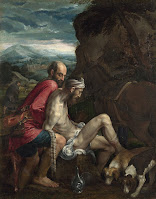
Painted Parables: Bassano’s “Good Samaritan” and the gospel of Luke

Image
Interesting online lecture from the National Gallery looking at how two artists have represented parables from St Luke’s Gospel. Chloe Church, a curatorial trainee, looked at “The Good Samaritan” by Jacopo Bassano from 1562-3 in National Gallery and “The Blind Leading the Blind” by Domenico Felti from 1621-2 in the Barber Institute. She talked us through what a parable is and why there are more in Luke’s gospel than the other three. Luke was a great storyteller. She then examined how well the pictures put across the parables and their message pointing out some of the details in them. She concluded that the National Gallery picture still tells the story well but the Barber Institute one, while presenting the saying clearly, uses some ideas we now find difficult such as equating blindness and sin.  

Watteau and Chardin: New Directions in French Painting

Image
Delightful all day course from the London Art History Society on French 18th century artists Watteau and Chardin. Clare Ford-Willie began with a good overview of art in France in the century before to set the scene and to pinpoint where some of the themes of the later artists came from. At times she did gloss over some of the history assuming we knew it but she had provided a good handout with more of the detail which helped those of us who in true historian tradition can say “it’s not my period. She then looked at the work of each artist separately as they work in very different genres. She talked about how Watteau was born in a Flemish area and how we can see the influence of this in his work. She talked about the decorative work he did and then his pictures of contemporary people in autumnal landscapes and his use of Commedia dell’arte figures. We moved onto Chardin and looked at his still-lives and talked about how he liked placing shapes together, simplifying the composition...